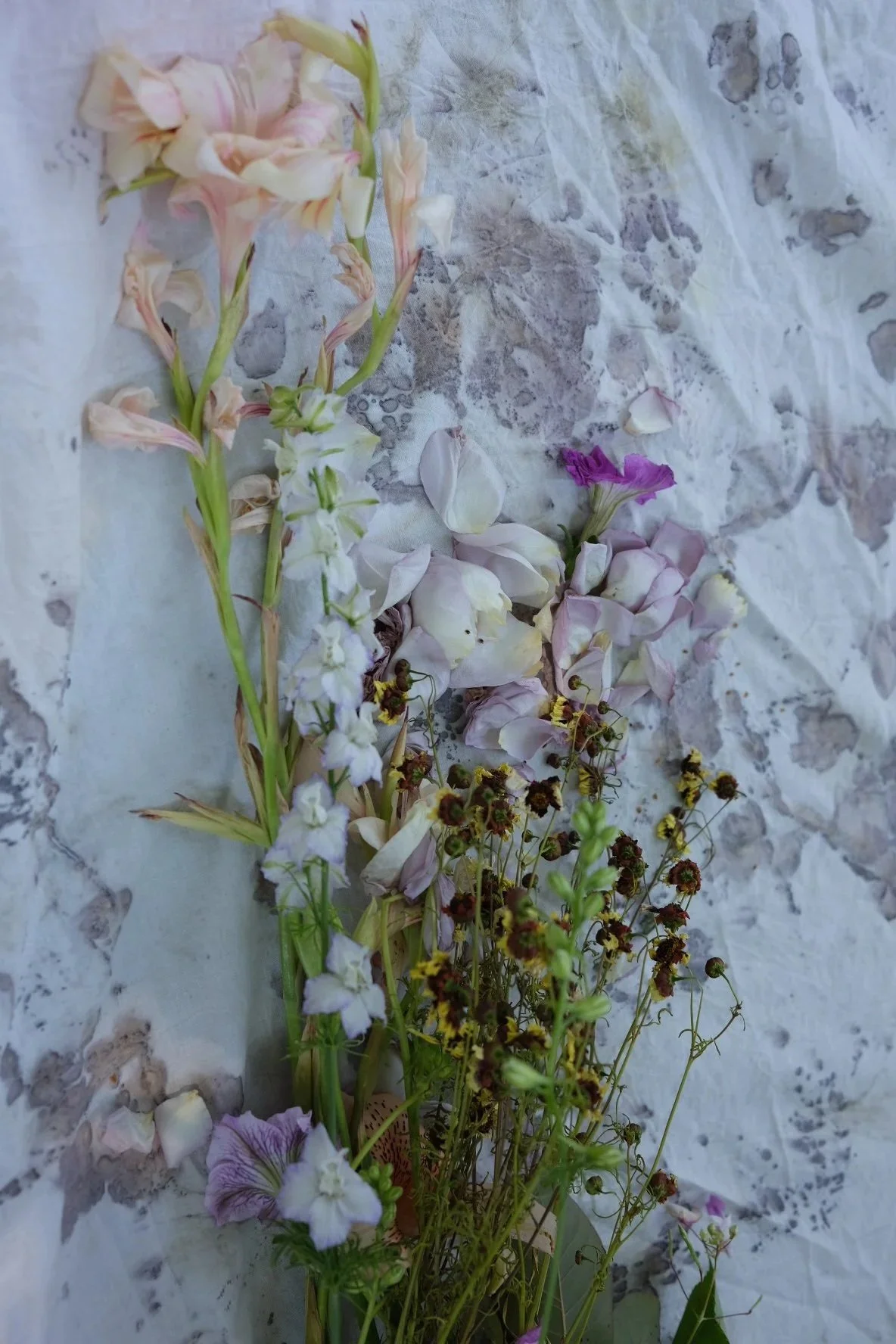
Natural Dye Plants by Color
Natural dyes can produce an extraordinary range of colors, from soft botanical neutrals to brilliant yellows, oranges, reds, pinks, purples, blues, and greens. The final color depends on the plant, the part used, fiber, mordant, water, pH, temperature, and dyeing method.
YELLOWS, GOLDS & CHARTREUSE
Calendula — Flowers
Clear yellow to golden yellow; can produce warmer shades with different mordants.
Chamomile — Flowers
Soft buttery yellow to warm gold.
Dahlia — Flowers
Yellow, gold, orange, peach, and sometimes rosy tones depending on the flower color.
Goldenrod — Flowers
Bright yellow to golden yellow.
Tansy — Flowers
Strong yellow to yellow-green.
Weld — Whole plant
One of the classic natural yellow dyes. Produces clear, luminous yellows and can be shifted toward green with indigo. Weld is a perennial/biennial and develops a deep taproot; it is best established in the ground before harvesting.
Yarrow — Flowers and plant parts
Warm ivory, pale yellow, buttery yellow, and sometimes olive tones.
Marigold (Tagetes spp.) — Flowers
Bright yellow, gold, orange, and chartreuse.
Dyer’s Coreopsis (Coreopsis tinctoria) — Flowers
Golden yellow through orange and rust; particularly useful for warm, saturated colors.
Cosmos (Cosmos sulphureus) — Flowers
Yellow, gold, orange, and warm rust tones.
C. bipinnatus can produce berry and pinkish tones.
Onion skins — Skins
Golden yellow, amber, orange, and coppery tones. One of the easiest and most reliable household dye materials.
Turmeric — Rhizome
Brilliant yellow to orange-yellow. Can shift toward olive or deep green when combined with indigo. Color is relatively fugitive.
St. John’s Wort — Flowers and plant parts
Yellow, golden, olive, and greenish tones depending on method and mordant.
Carrot tops — Leaves
Soft yellow to yellow-green.
Daffodil — Flowers
Soft yellow to golden yellow. Generally more useful as an experimental dye than as a primary production dye.
Catnip — Plant parts
Soft yellow to greenish yellow.
Cota / Golden Chamomile — Flowers
Yellow to golden tones.
Fennel — Leaves, stems, flowers
Yellow-green, olive, and soft greenish tones.
ORANGES, RUSTS & COPPERS
Dyer’s Coreopsis — Flowers
One of the best plants for warm orange, rust, and reddish-orange shades.
Marigold — Flowers
Golden orange through warm orange.
Dahlia — Flowers
Orange, apricot, copper, and warm gold depending on variety.
Cosmos sulphureus — Flowers
Orange, pumpkin, rust, and terracotta tones.
Onion skins — Skins
Orange, copper, amber, and russet.
Madder — Root
Orange, brick red, terracotta, and deep red. Madder is a perennial with a long establishment period; roots are generally harvested after multiple years for stronger color.
PINKS, ROSES & MAUVES
Amaranth — Flowers
Pink, magenta, raspberry, purple, and burgundy tones. Often fugitive.
Roses — Petals
Soft blush, pink, dusty rose, mauve, lavender, and tan depending on variety and dye conditions. Rose petals are generally more useful for delicate, ephemeral colors than highly lightfast dyes.
Peonies — Petals
Soft pink, blush, peach, mauve, and lavender tones depending on flower color. Beautiful for experimental and seasonal dyeing; many peony colors are relatively fugitive.
Hibiscus — Flowers
Pink, magenta, burgundy, and purple-red tones. Highly pH-sensitive and generally fugitive.
Cosmos bipinnatus — Flowers
Pink, rose, berry, and mauve tones.
Sorrel — Root
Pink, coral, peach, and reddish tones depending on species and process.
Birch — Bark
Pinkish beige, blush, tan, and warm brown tones.
REDS, BRICK & DEEP RUST
Madder (Rubia tinctorum) — Root
One of the most important natural red dyes. Produces orange-red, brick, terracotta, coral, and deep rich reds. Madder benefits from several years of growth before harvesting.
Lady’s Bedstraw — Root
Yellow through orange, coral, and red depending on extraction and mordant. A relative of madder.
Dyer’s Coreopsis — Flowers
Golden yellow through orange, rust, and reddish tones.
Dandelion — Root
Warm yellow, orange, rust, and brownish tones depending on extraction.
Spruce — Cones and bark
Warm reddish brown, rust, and brown tones.
PURPLES, VIOLETS & LAVENDERS
Violet (Viola spp.) — Flowers
Soft lavender, violet, mauve, blue-violet, and gray-purple. Highly pH-sensitive and generally delicate/fugitive.
Red Cabbage — Leaves
Lavender, purple, blue, silver-gray, and blue-green depending strongly on pH.
Black Hollyhock — Flowers
Purple, plum, burgundy, gray-purple, and mauve.
Black Knight Scabiosa — Flowers
Deep plum, burgundy, purple, and sometimes unusual greenish or chartreuse tones.
Echinacea — Flowers
Soft pink, mauve, lavender, tan, and muted purple depending on variety and process.
Grapes — Skins
Purple, lavender, gray, and blue-purple tones. Generally sensitive to pH and light.
Blackberries — Fruit
Purple, blue-purple, mauve, and gray. Beautiful but highly fugitive.
Mulberries — Fruit
Purple, wine, burgundy, blue-purple, and gray tones. Generally fugitive.
Lavender — Flowers
Soft beige-yellow, pale lavender, dusty gray, and muted purple-gray.
BLUES
Indigo — Leaves
The classic natural blue dye. Produces a remarkable range from pale sky blue through denim and deep midnight blue. Indigo is developed through a reduction vat rather than a conventional heated dye bath.
Japanese Indigo (Persicaria tinctoria) — Leaves
Produces clear blue through deep indigo. An excellent annual crop for the garden and particularly well suited to small-scale dye gardens.
Woad (Isatis tinctoria) — Leaves
A traditional European indigo source. Produces blue through blue-green shades.
Red Cabbage — Leaves
Blue, blue-purple, lavender, and gray-blue depending on pH. Unlike indigo, these colors are not comparable in lightfastness.
GREENS & OLIVES
True green is often created by overdyeing yellow with indigo rather than extracting a green pigment directly from a plant.
Weld + Indigo
Clear, luminous greens through deeper forest and olive greens.
Turmeric + Indigo
Bright yellow-green through deeper olive greens. Turmeric is relatively fugitive.
St. John’s Wort — Flowers and plant parts
Yellow-green, olive, and muted green.
Fennel — Plant parts
Yellow-green and soft olive.
Mint — Leaves and stems
Soft yellow-green, gray-green, and muted olive tones.
Artichoke — Plant parts
Soft yellow-green, olive, and muted green.
Black-eyed Susan / Rudbeckia hirta — Flowers, leaves and stems
Yellow, olive, greenish yellow, and warm neutral tones.
Hyssop — Plant parts
Yellow-green and olive tones.
Ivy — Leaves
Yellow-green, olive, and muted green.
Black Knight Scabiosa — Flowers
Can produce unusual chartreuse and greenish tones under certain conditions.
BROWNS, TANS & NEUTRALS
Comfrey — Leaves
Soft yellow-green, beige, gray-green, and brownish neutrals.
Larch — Needles and bark
Yellow, tan, olive, warm brown, and muted neutrals.
Wild American Plum — Root and bark
Warm beige, brown, reddish brown, and muted rose-brown.
Birch — Bark
Cream, blush, tan, warm brown, and pinkish beige.
Spruce — Cones and bark
Rust, reddish brown, and warm brown.
Walnut — Hulls
Rich tan, caramel, warm brown, and deep chocolate brown. A particularly useful dye for strong, durable browns.
Oak — Bark, leaves and galls
Tan, beige, brown, gray, and near-black when combined with iron.
GRAYS, CHARCOALS & BLACKS
Alder — Bark
Gray, brown, charcoal, and dark neutral shades, particularly with iron.
Iris — Roots
Yellow, greenish, gray, and muted dark tones depending on species and mordant.
Poplar — Leaves and bark
Yellow-green, tan, gray, and muted brown.
Lavender — Flowers
Soft beige, gray, lavender-gray, and dusty neutrals.
Red Cabbage — Leaves
Silver gray, lavender-gray, blue-gray, and charcoal-like tones depending on pH and mordant.
Oak + Iron
Gray through charcoal and near-black.
Alder + Iron
Gray, charcoal, and dark gray-black.
GOOD SPRING PLANTS FOR A DYE GARDEN
These are particularly useful additions if the goal is to plant in spring and grow a small dye garden:
Annuals — especially easy to grow from seed
Marigold
Dyer’s Coreopsis
Cosmos sulphureus
Cosmos bipinnatus
Japanese indigo
Amaranth
Sunflower
Calendula
Chamomile
Dill
Fennel
Basil, including purple basil
Hollyhock
Perennials / plants worth establishing
Weld
Madder
Yarrow
Lady’s Bedstraw
Goldenrod
Dyer’s chamomile / Cota
Echinacea
Dyer’s mint / mint varieties
St. John’s Wort
Particularly valuable additions
Japanese Indigo — An excellent choice for a home dye garden because it is an annual and can produce substantial quantities of blue leaves in one growing season.
Madder — Worth growing for the long term if red is important to your palette. The roots need time to develop, so this is a plant to establish and leave in place.
Weld — One of the most valuable plants for clear, luminous yellow and for creating greens with indigo. It prefers not to be transplanted once established.
Marigold — Extremely productive, easy to grow, and excellent for yellow, gold, orange, and green-overdye experiments.
Dyer’s Coreopsis — One of the best choices for a small dye garden because it flowers abundantly and offers yellow, orange, rust, and red-orange possibilities.
Cosmos — Productive, beautiful, and particularly useful if you want to explore both yellow/orange and berry/pink colors.
Yarrow — A hardy perennial that provides soft yellow and warm botanical colors.
Goldenrod — A productive perennial source of bright yellow.
A NOTE ABOUT COLOR
The categories above describe color possibilities rather than guaranteed results. Natural dyes are influenced by many variables, including:
the species and variety of plant
which part of the plant is used
fresh versus dried material
growing conditions and harvest time
fiber type
mordant
water chemistry
pH
temperature
extraction method
length of dye time
oxidation
whether the fabric is overdyeed
Some natural colors—particularly those from berries, violets, roses, peonies, red cabbage, and many flower petals—are beautiful but relatively fugitive. They are wonderful for experimentation and botanical color studies, while dyes such as indigo, madder, weld, and many tannin-based dyes are generally better choices when long-term lightfastness is important.